In 2026 packaging operations, profit is often limited by changeover time, not maximum speed. When you run multiple SKUs, bag sizes, and product types, a traditional mechanical setup creates frequent stops for manual adjustments, alignment, and troubleshooting. A servo-driven VFFS machine improves control over film motion, sealing timing, and bag length accuracy — helping teams cut downtime and return to stable production faster. This guide explains the practical advantages and what to check when evaluating a VFFS machine for sale.
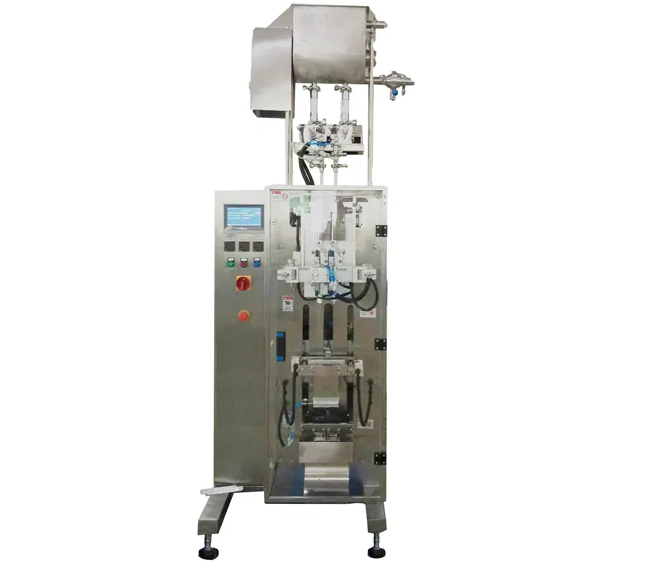
VFFS Machine Downtime: Why Changeovers Slow Packaging Lines
Where Time Is Actually Lost
Most packaging managers track maximum line speed as the primary productivity metric. But on a high-mix line running six or eight different SKUs per day, the time lost between production runs — not the speed during production — determines actual output.
| Changeover Activity | Traditional Mechanical Machine | Servo-Driven VFFS Machine |
|---|
| Bag length adjustment | Manual cam or mechanical stop adjustment; 10–25 minutes | Parameter change on HMI; recipe stored; under 2 minutes |
| Film pull calibration | Manual tension adjustment; trial-and-error | Servo position control; precise and repeatable |
| Sealing jaw timing | Mechanical adjustment; requires specialist | Parameter-based; operator-accessible |
| Forming collar change | Typically manual; collar stored separately | Quick-release mounting; standardized between sizes |
| Startup scrap after changeover | Often 20–50 bags until stable | Typically 5–10 bags; servo returns to calibrated position |
The Cost of Downtime at Scale
For a line producing 60 bags per minute running six product changes per day, each 20-minute changeover is 1,200 bags of lost output. At a conservative product value of USD 0.80 per bag, each unnecessary changeover delay costs approximately USD 960 in lost throughput — before counting labor overtime and film waste.
Reducing average changeover time from 20 minutes to 8 minutes on a six-SKU operation recovers the equivalent of 1.2 hours of production per shift. This is where servo-driven systems create measurable ROI.
VFFS Machine Servo Control: Accuracy and Repeatability That Reduce Rework
What Servo-Driven Actually Means
In a traditional VFFS machine, film movement is driven by mechanical components — gears, cams, and timing belts that are physically adjusted to change bag length or seal timing. In a servo-driven machine, independent servo motors control each critical motion axis, and their behavior is defined by software parameters rather than physical adjustment.
| Motion Axis | Traditional Control | Servo Control |
|---|
| Film pull | Mechanical clutch/brake; fixed increments | Servo motor; precise length per cycle; sub-millimeter repeatability |
| Sealing jaw movement | Cam-driven; fixed timing curve | Servo; programmable timing; adjustable for film type |
| Cutting cycle | Mechanically synchronized | Independently controlled; adjustable cut position |
| Film tracking | Manual guide adjustment | Motor-assisted; some systems with automatic correction |
Performance Improvements That Affect Quality and Efficiency
Consistent bag length: servo pull rolls maintain exact film advance length every cycle — bag length variation is typically under ±1 mm versus ±3–5 mm on mechanical systems
Better seal positioning: precise timing coordination between film pull completion and jaw closure reduces the "jaw catches film in motion" problem that creates wrinkled seals
Smoother film handling: controlled acceleration and deceleration at the pull rolls reduces film stress — particularly important for thin or laminated films that stretch or delaminate under mechanical jerk
Reduced startup scrap: because the servo system returns to the exact stored position after a changeover, the first production bags after a recipe recall are typically within specification rather than requiring operator trimming
VFFS Machine for Sale: Changeover Features That Reduce Setup Time
Design Features That Make Changeovers Faster
When evaluating a VFFS machine for sale, changeover design deserves as much attention as maximum rated speed. A machine that runs at 80 bags per minute but requires 45 minutes to change over is less productive than a machine running at 60 bags per minute with 5-minute changeovers on a high-mix line.
| Changeover Feature | Benefit | What to Verify |
|---|
| HMI recipe storage | Store all parameters for each SKU; recall with one button | How many recipes can be stored; how are they organized by product |
| Guided setup prompts | HMI walks the operator through each adjustment step | Whether prompts include mechanical positions as well as parameters |
| Tool-less film path | Film threading path accessible without tools or guard removal | Confirm threading time in practice — not just in the sales demo |
| Quick-release forming collar | Collar locks and unlocks without tools; consistent positioning | Confirm collar alignment is automatically correct on reinstallation |
| Spare forming sets | Each bag format has its own collar/tube; no adjustment needed | Confirm the cost of additional forming sets for your full bag range |
What to Standardize Across Your Product Range
Even the best servo machine cannot eliminate changeover complexity if the product range uses incompatible bag formats. Before specifying a machine, review your SKU list and identify:
Bag width range: all bag widths that can share the same film width reduce film changeover frequency
Bag length range: confirm all required lengths are achievable within one forming collar's adjustment range where possible
Forming collar standardization: consolidate bag formats to minimize the number of separate forming collars required
VFFS Machine Integration: Synchronization That Prevents Changeover Failures
Why Changeovers Fail at the System Level
A servo-driven VFFS machine can change parameters in two minutes while the upstream weigher requires 15 minutes to change from one product to another. The system changeover time is determined by the slowest element — and that element is rarely the VFFS machine itself on a well-specified servo system.
| Integration Point | Changeover Consideration |
|---|
| Multihead weigher | Target weight programmed per recipe; product change may require physical hopper cleaning |
| Auger filler | Auger pitch and speed reprogrammed; product path cleaned if allergen separation required |
| Nitrogen flush | Flow rate and timing stored per recipe; no additional adjustment on modern systems |
| Date coder | Date format and position stored per recipe; confirm code position does not conflict with seal zone |
| Reject system | Reject threshold and tolerance stored per recipe; prevent mixed-SKU contamination |
Controls and Data Integration
A servo VFFS machine connected to a central line control system provides:
Recipe download from a line management system: eliminates operator parameter entry and the errors it creates
Production data output: actual bag count, film usage, seal temperature log, and downtime events exported per production run
Alarm and fault logging: seal temperature out-of-range, film break, weigher communication loss — all logged with timestamp for production review
VFFS Machine for Sale Buying Checklist: Specifications and Validation
Quote-Ready Technical Requirements
| Parameter | What to Define | Notes |
|---|
| Product type | Powder, granule, liquid, mixed | Determines filler type and sealing system |
| Target speed | Bags per minute at your typical bag size | Confirm at the largest bag, not the smallest |
| Bag style | Pillow, gusseted, quad seal, flat bottom | Each style may require specific forming tooling |
| Film width range | Minimum and maximum film roll width | Defines the machine's forming collar range |
| Bag size range | Width × length (min and max) | Confirm all required bag sizes within the servo system's range |
| Sealing method | Continuous or intermittent; jaw type | Depends on film type and sealing requirements |
| Number of daily changeovers | Expected frequency of SKU changes | Key input for justifying servo vs mechanical cost |
Validation Tests Before Purchase
| Test | Method | Pass Criteria |
|---|
| Changeover time trial | Time a complete product change including parameter recall, film change, and startup | Within your target changeover window |
| Seal strength test | Peel force test on 20 samples from production run | Meets minimum required seal strength for your film |
| Bag length accuracy | Measure 50 consecutive bags and calculate standard deviation | Within ±1 mm for servo systems |
| Startup scrap after changeover | Count bags before first accepted bag post-changeover | Under 10 bags on a stable servo system |
| Registration accuracy | Measure print-to-cut registration on 20 samples | Within ±1.5 mm for registered film |
Support and Maintenance Planning
Spare parts: servo motors, film pull rollers, sealing jaw elements, and forming collars are the highest-priority spares — confirm stock availability and lead time
Remote diagnostics: many current VFFS machines for sale include remote PLC access or camera support for fault diagnosis without a service visit
Training: confirm that operator training covers recipe creation and parameter adjustment — operators who can create new recipes independently reduce reliance on service visits
Conclusion
For high-mix packaging lines, the most productive VFFS machine is not always the fastest — it is the one that returns to stable production most quickly after every SKU change. A servo-driven VFFS machine reduces adjustment time, improves bag length and seal repeatability, and lowers startup scrap after changeovers. When evaluating a VFFS machine for sale, prioritize changeover design, recipe control capability, and integration readiness alongside rated production speed. When evaluating industrial automatic packaging machines for sale, prioritize changeover design, recipe control capability, and integration readiness alongside rated production speed.
FAQ
Q1: What is a VFFS machine used for?
A VFFS (vertical form-fill-seal) machine forms bags from a flat roll of film, fills each bag with product from above, and seals it closed in one continuous automated process. It is widely used for snacks, coffee, protein powder, pet food, fresh produce, and many other packaged goods where a sealed film bag is the required format.
Q2: How does a servo-driven VFFS machine reduce downtime compared to a mechanical machine?
Servo drives control film pull, sealing jaw movement, and cutting with software-defined parameters rather than physical mechanical adjustments. This means bag length and seal timing changes are made on the HMI as a parameter input rather than requiring manual adjustment of cams or mechanical stops. The combination of recipe recall and servo position accuracy reduces changeover time from 20–30 minutes to 5–10 minutes and reduces startup scrap from 30–50 bags to under 10 bags.
Q3: What changeover features are most important when evaluating a VFFS machine for sale?
Recipe storage and one-button recall, tool-free film threading, quick-release forming collar mounting, and guided HMI setup prompts are the most impactful changeover features. Verify each feature in a live demonstration at your actual operating speed rather than accepting a specification claim — the real changeover time with your operators on your products is what matters.
Q4: Does servo control improve package quality beyond reducing downtime?
Yes. Servo control of the film pull system provides sub-millimeter bag length consistency across a production run. Servo-controlled sealing jaw timing reduces the variation in dwell time that causes inconsistent seal strength. Better film handling with controlled acceleration reduces stress on thin or laminated films. The combined effect is more consistent bag appearance, fewer wrinkled seals, and more stable registration on pre-printed films.
Q5: What information should I provide to get an accurate VFFS machine for sale quotation?
Provide the product type and physical characteristics (powder, granule, or liquid), required production speed in bags per minute, bag style (pillow, gusseted, flat bottom, or quad seal), film width and type, complete bag size range including minimum and maximum dimensions, filling system preference (multihead weigher, auger, or pump), how many SKU changes occur per shift, and whether nitrogen flushing, date coding, or reject integration is required.


 To Know Alpha-Pack More