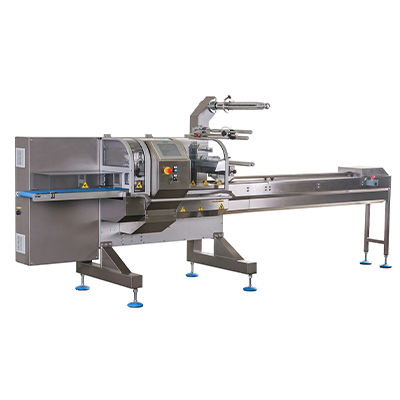
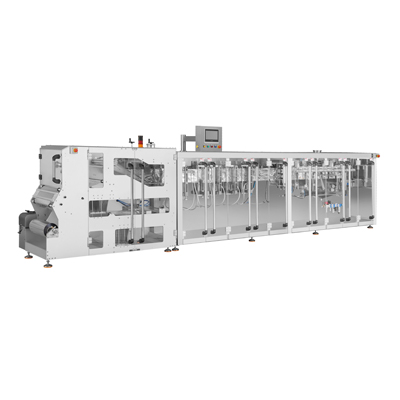
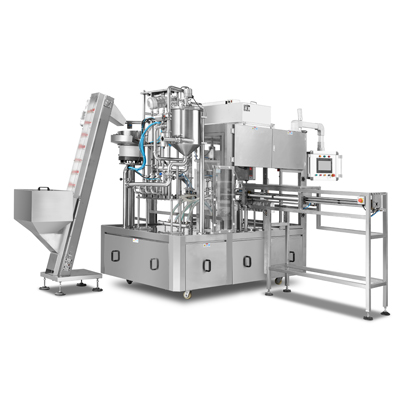
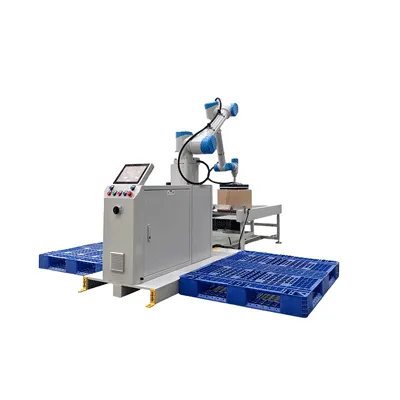
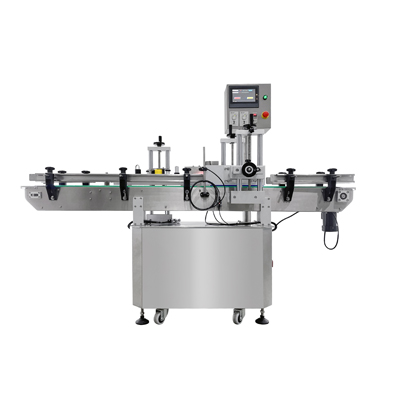
Bakery and produce packaging lines face constant hygiene pressure: moisture, crumbs, sugars, and organic residues can quickly become contamination risks if equipment is hard to clean or prone to corrosion. A stainless-steel flow wrapper supports food safety by enabling faster sanitation, resisting rust, and maintaining stable sealing performance after repeated washdowns. This guide explains what to look for when sourcing a flow wrapping machine China solution that meets modern food plant expectations.
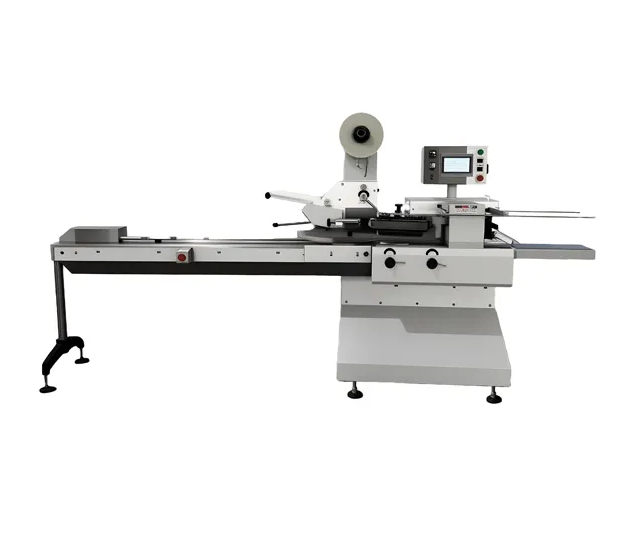
Flow Wrapping Machine China Compliance: What Food Safety Standards Require
Why Compliance Is an Engineering Decision
Food safety compliance is not achieved by adding a cleaning protocol to a poorly designed machine — it is built into the machine's physical construction. A packaging line that passes audit requires equipment where contamination is prevented by design, not managed by effort.
| Risk Point | Poorly Designed Machine | Hygienic Design Solution |
|---|
| Crevices and seams | Bacteria harbor at unsealed internal joints | Smooth, crevice-free welded construction |
| Exposed fasteners | Threads accumulate product residue | Flush or recessed fasteners; smooth external surfaces |
| Trapped water zones | Standing water after washdown promotes microbial growth | Sloped surfaces draining to defined exit points |
| Film path access | Film path cannot be cleaned without tools | Open-frame construction; tool-free access panels |
| Conveyor belt edges | Product debris accumulates at belt edges and rollers | Removable belts; accessible roller ends |
Common Audit Failures in Packaging Equipment
The most frequent packaging equipment findings in food safety audits relate to:
Horizontal ledges that accumulate dust, crumbs, or condensate
Control cabinet bottom plates that collect debris with no drainage
Sealing jaw housings with internal cavities inaccessible to cleaning
Non-food-grade lubricants used on food-contact adjacent components
When selecting a flow wrapping machine China supplier, request a sanitation procedure and time trial before purchase — not a claim that the machine is "easy to clean."
Flow Wrapper Stainless Construction: Hygienic Design That Prevents Bacteria and Rust
Why Stainless Steel Is the Starting Specification
| Material Property | 304 Stainless Steel | Carbon Steel or Painted Steel |
|---|
| Corrosion resistance | Excellent — withstands cleaning chemicals and moisture | Rusts under repeated washdown; painted surfaces chip |
| Surface cleanability | Smooth and non-porous when properly finished | Porous or rough surfaces harbor microorganisms |
| Chemical tolerance | Resistant to alkaline and acidic cleaning chemicals | Degrades with aggressive cleaning chemistry |
| Long service life | Maintains surface integrity over years of daily cleaning | Requires surface maintenance or replacement |
Hygienic Design Features That Reduce Sanitation Time
| Design Feature | Sanitation Benefit |
|---|
| Open-frame structure | Water and cleaning chemical flush through without pooling |
| Sloped horizontal surfaces (minimum 3°) | Condensate and wash water drain without standing |
| Smooth, ground welds | No crevice at weld joints; surfaces fully cleanable |
| Removable conveyor belts | Belt removed in minutes for full access to contact surfaces |
| Hinged and tool-free access panels | Film path and sealing zone accessible for every cleaning shift |
| Stainless conveyor components | No corrosion at product contact; no contamination source |
Audit Readiness
A machine with genuine hygienic design supports audit preparation rather than creating it. Clean-down completion time is measurable — request the supplier's documented sanitation procedure and confirm it is achievable with your shift timing before committing to the purchase.
Flow Wrapper for Bakery: Crumb Control, Sealing, and High-Speed Output
Why Bakery Is a High-Maintenance Application
Bakery products introduce three simultaneous challenges: crumbs and flour dust that accumulate in every accessible space, sticky glazed or sugar-coated surfaces that transfer to machine components, and product size variation within the same product line.
| Bakery Challenge | Machine Design Response |
|---|
| Crumb and dust accumulation | Sloped conveyor frames; smooth internal surfaces; no horizontal ledges below the product path |
| Sticky residue on sealing jaws | Non-stick jaw surface treatment; easy jaw removal for cleaning |
| Variable product height | Film tension control system that accommodates height variation; adjustable infeed |
| Fragile products | Gentle infeed with controlled compression at the sealing station |
Sealing Performance Requirements for Bakery
Seal quality in bakery applications is visible to the consumer at the point of purchase. An inconsistent seal — too hot, too compressed, or applied unevenly — distorts the package appearance on a soft roll or cake and creates a return risk.
Jaw temperature control: independent top and bottom jaw control is standard — different products have different seal profiles
Seal dwell time: adjustable dwell allows fine-tuning for variable product thickness and film type
Film tracking: consistent film tracking prevents edge misalignment that produces incomplete seals
Maintenance Considerations
Quick-change sealing jaws: field-replaceable jaws reduce maintenance time from two hours to under twenty minutes
Tool-free crumb access: the area below the product conveyor accumulates crumbs the fastest — this zone requires daily access and must be cleanable without tools
Flow Wrapping Machine China for Produce: Moisture, Condensation, and Film
Why Produce Is a Different Technical Challenge
Produce packaging lines deal with conditions that accelerate equipment degradation — wet product surfaces, temperature differentials that create condensation, and the cold-chain requirement that keeps the entire environment near or below 10°C during operation.
| Produce Challenge | Risk Without Design Response |
|---|
| Wet product surface | Moisture transfers to sealing zone; affects seal integrity |
| Condensation from temperature differential | Condensate on machine surfaces promotes corrosion and microbial growth |
| Cold operating environment | Some lubricants and plastics perform poorly at low temperatures |
| Variable product geometry | Irregular produce shapes require flexible film tension and forming geometry |
Machine Features That Address Produce Requirements
Sealed stainless enclosures: electrical components and drives sealed against moisture ingress
Corrosion-resistant conveyor: all conveyor rollers, frames, and belts in stainless or food-grade polymer
Drainage design: every horizontal surface sloped and drained; no water pooling at the end of each shift
Seal performance on moist packages: sealing jaw temperature profile optimized for the moisture conditions at your specific product — always validate with your actual product at the production operating temperature
Packaging Film Considerations for Produce
Film selection affects both machine performance and product shelf life:
Anti-fog film reduces condensation visibility inside the pack — requires confirmation that the flow wrapper's film handling system manages anti-fog coating without adhesive contamination of the sealing zone
Micro-perforated film for respiring produce requires correct perforation pattern relative to the film's directional strength — confirm the machine can run perforated film without tearing at the forming shoulder
Modified atmosphere packaging (MAP) is application-specific and requires gas flush integration at the machine — confirm this is a factory-fitted option, not a field retrofit
Flow Wrapper Buying Checklist: Specs, Testing, and Service Support
Quote-Ready Technical Specifications
| Parameter | What to Specify | Notes |
|---|
| Product dimensions | Length × width × height range | Include the largest and smallest products in your range |
| Target packs per minute | At your typical product size | Confirm at the most challenging product, not the easiest |
| Film type | OPP, PP, PLA, anti-fog, perforated | Confirm the machine is validated for your specific film |
| Bag length range | Minimum and maximum | Defines the seal cycle requirements |
| Sanitation classification | Wet or dry environment; washdown rating | Defines IP rating and stainless scope |
| Integration requirements | Infeed conveyor, date coder, outfeed scale | Confirm as factory-fit options |
Validation Tests to Request Before Purchase
| Test | Method | What It Confirms |
|---|
| Seal strength | Peel force test on production samples | Seal holds under handling and distribution |
| Sanitation time trial | Timed full clean-down by your operating crew | Clean-down achievable within your shift window |
| Production run with your product and film | 30-minute continuous run at target speed | Confirms film tracking, seal consistency, and jam rate |
| Cold temperature performance (produce) | Run at operating temperature | Confirms performance in your actual environment |
Long-Term Service Support
Spare parts list: confirm the specific wear parts (sealing jaws, film guides, conveyor belts) are available from local stock or with defined lead time
Maintenance schedule: written schedule of daily, weekly, and monthly maintenance tasks specific to the model
Remote diagnostics: many flow wrapping machine China suppliers now offer remote fault diagnosis via camera or PLC access — reduces service call cost and downtime
Conclusion
A stainless-steel flow wrapper is not just a packaging upgrade — it is a food safety and uptime strategy. For bakery and produce lines, hygienic construction reduces contamination risk, shortens sanitation downtime, and maintains reliable sealing performance under real plant conditions. When choosing a flow wrapping machine China supplier, prioritize cleanability, corrosion resistance, and validation with your specific products rather than accepting specification claims without physical testing.
FAQ
Q1: What is a flow wrapper used for in food packaging?
A flow wrapper wraps individual products in a continuous film, forms a fin seal along the length, and cross-seals both ends to create a fully enclosed package. It is used for bakery items (rolls, croissants, bars), fresh produce, snacks, and any regular-geometry food product requiring a sealed wrapper for retail presentation or shelf-life protection.
Q2: Why is stainless steel construction important for food-safe flow wrapping?
Stainless steel resists corrosion from the moisture, organic residues, and cleaning chemicals present in bakery and produce environments. It maintains a smooth, non-porous surface that supports thorough cleaning and bacterial removal across thousands of cleaning cycles over the machine's service life. Carbon steel or painted surfaces rust and deteriorate, creating crevices and contamination sources that cannot be reliably cleaned.
Q3: What hygienic design features should I prioritize when selecting a flow wrapper?
The most important features are open-frame construction that allows flush cleaning, sloped horizontal surfaces that drain without pooling, smooth crevice-free weld joints, tool-free access panels on the film path and sealing zone, removable conveyor belts for full access to contact surfaces, and flush or recessed fasteners that do not accumulate product residue.
Q4: Can a single flow wrapper handle both bakery and produce product lines?
It depends on the specific machine configuration and your product range. Bakery requires crumb management and dry-environment construction; produce requires wet-environment sealing and cold-temperature performance. Some machines are configured for both with the correct options specified. The most reliable approach is to validate with both product types during the factory acceptance test before purchase.
Q5: What technical information should I provide to get an accurate flow wrapper quotation?
Provide product dimensions (length, width, height) for your full range, target packs per minute at typical product size, film type including any special requirements (anti-fog, perforated, MAP-compatible), bag length range, sanitation classification (wet or dry environment, IP rating requirement), operating temperature, and any integration requirements such as infeed conveyors, date coders, or downstream weighing equipment.



 To Know Alpha-Pack More